
20 Butterfly Nursery Ideas 2026
When you’re trying to create a butterfly nursery, the true challenge usually starts after the first few Pinterest saves.
Everything seems pretty in images, but when you actually think of your own space it gets muddled very fast.
Too many pink tones, odd butterfly decals, and no clear notion of where things should go.
Most individuals either wind up over-decorating the area or making it too simple and missing the whole motif.
In this article, you’ll learn how to design a butterfly nursery that feels soft, balanced, and actually grows with your child.
Let’s jump in!
How Do You Design a Butterfly Nursery?
If you want a butterfly nursery that doesn’t feel ‘too babyish’ a year from now, you need to stop decorating like it’s a theme and start planning like it’s a room.
The biggest error people make is to plaster every nook and cranny with butterflies, pink accents and matching sets of decor.
Save this article for later!👇👇👇
Looks excellent first but gets overwhelming quickly and difficult to update later.
Just keep your base simple. Use neutral walls and light furnishings and only include butterfly features in spaces.
This way, when your child gets older, you just remove or change the soft layers and don’t have to redecorate the entire room.
Canopy Calm
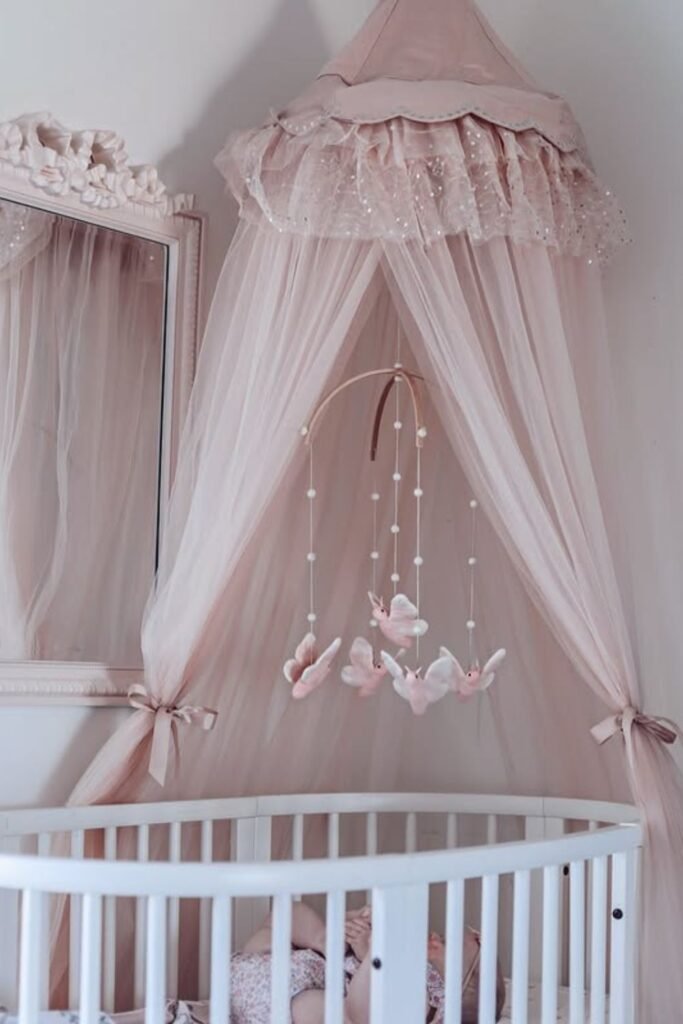
Placing a soft canopy above the crib instantly changes the whole sleeping corner into a protected, cozy zone instead of just a regular bed setup.
In this design, the canopy is the major visual anchor, so you don’t need heavy wall decor or too many butterfly details throughout the room.
Place it right above the crib to establish a sleep place, but keep the surrounding walls to a minimum so the fabric and soft textures can shine.
The hanging butterfly mobile creates a soft movement, making the space feel alive without being visually busy.
Try lightweight fabrics like tulle or sheer cotton in muted pink or blush tones to create this appearance.
This works best in smaller to larger nurseries where you want one powerful focus point instead of decorating every wall.
Lavender Gallery
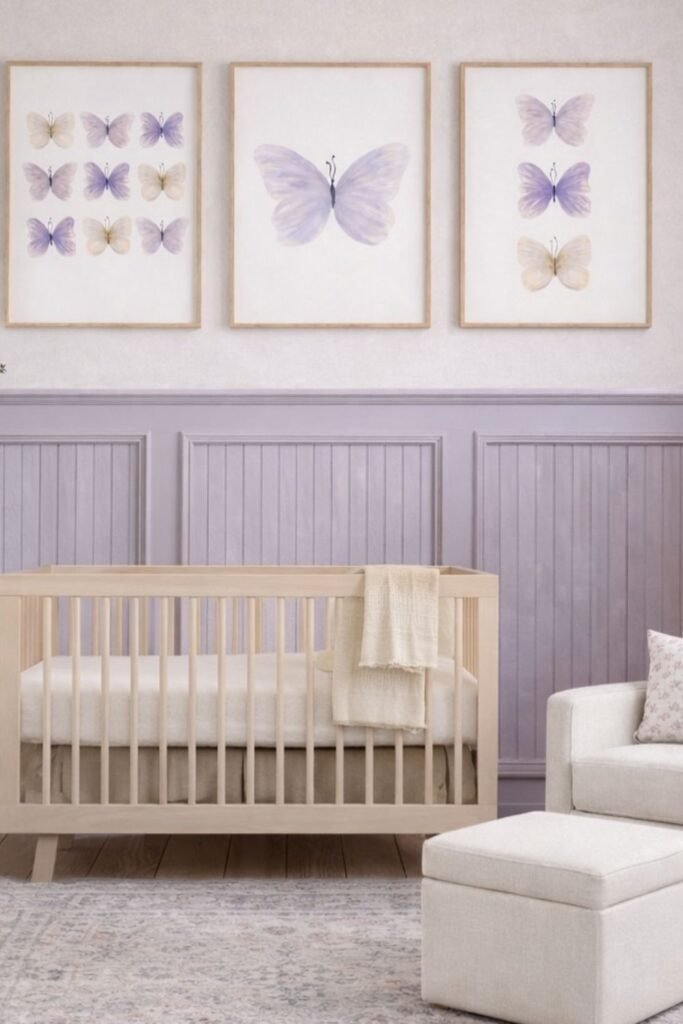
Keeping the wall as a calm storytelling space works better than filling the nursery with scattered butterfly décor everywhere.
The framed butterfly artwork is the highlight of the design in this configuration, which means that the remainder of the space is visually light and easy to clean.
Hang the crib precisely under or slightly off-center from the grouping of artwork.
So that the eye naturally aligns the resting space of the baby with the gentle visual theme above.
This provides structure without needing any other decor items in the room.
To achieve this, employ a restrained palette of colors gentle lavender, muted beige and light ivory to impart an elegance.
Butterfly Corner
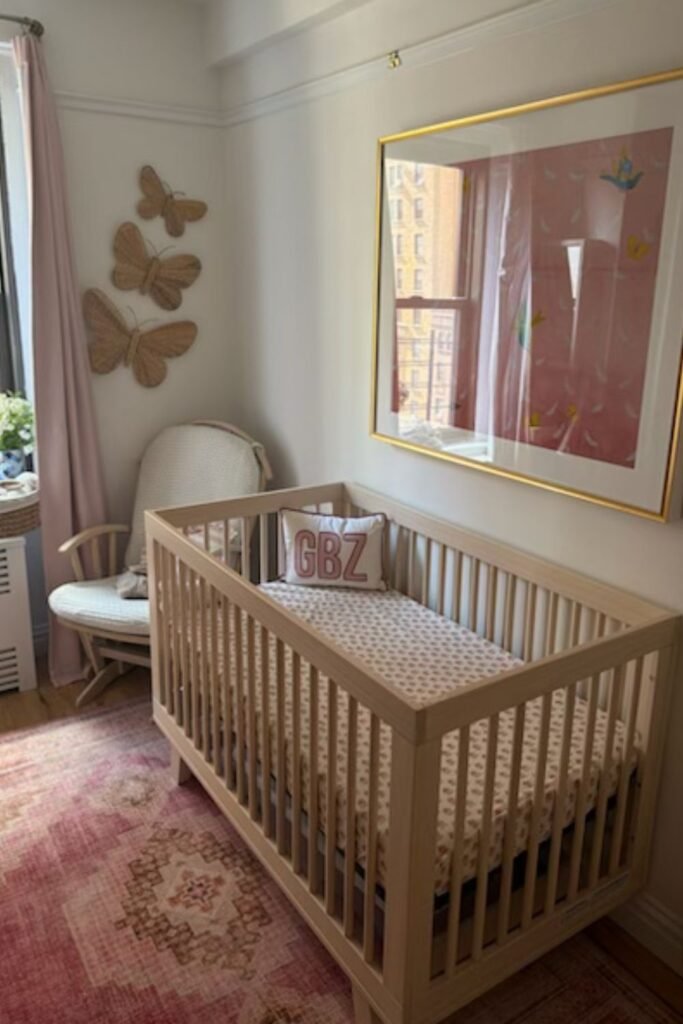
A nursery feels more intentional when you stop spreading décor across every wall and instead build one clear focal corner.
Here, the butterflies are positioned on one side wall, thereby creating a visual pause rather than visual clutter.
When positioned near the crib area or reading chair, they organically connect the child’s resting and interacting areas.
So the space feels structured without requiring extra decor everywhere. The large framed painting across the wall balances the weight of the space.
So it does not lean too much in one direction. For this design, pick one wall and stick with it don’t just randomly throw butterfly things over the room.
Throw in some textured wall pieces and framed paintings, but maintain a tight color palette so that the butterflies appear soft, not like ornamental overkill.
Ribbon Harmony
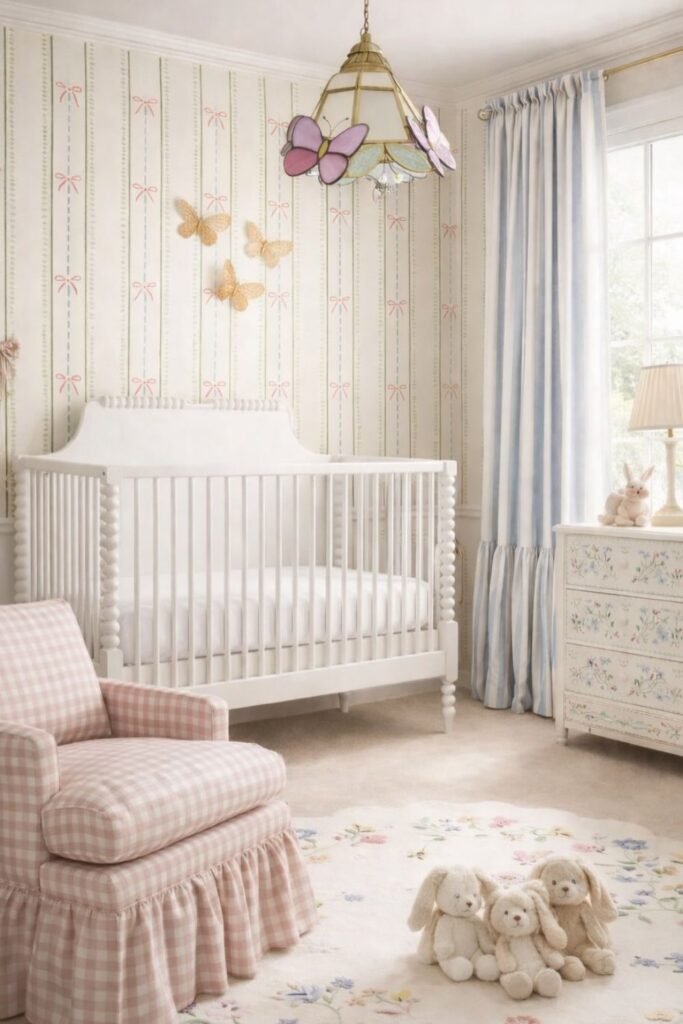
A nursery doesn’t always need heavy butterfly styling to feel thematic sometimes structure in the wall design does most of the work.
Here the vertical ribbon-pattern wallpaper already establishes a rhythm in the room, so the butterfly accents are just supporting the flow.
The crib against this patterned wall works because it is contained within a controlled visual grid, creating an orderly area rather than a cluttered one.
The butterflies serve as light “interruptions” in the pattern, and help to keep the theme from being overpowering, but still present.
To mimic this concept, start with a wallpaper or wall treatment that has direction, stripes, bows or vertical movement existing.
This works well in spaces where you want a soft decorative identity but don’t want to make the nursery a fully themed character place.
Cloud Canopy
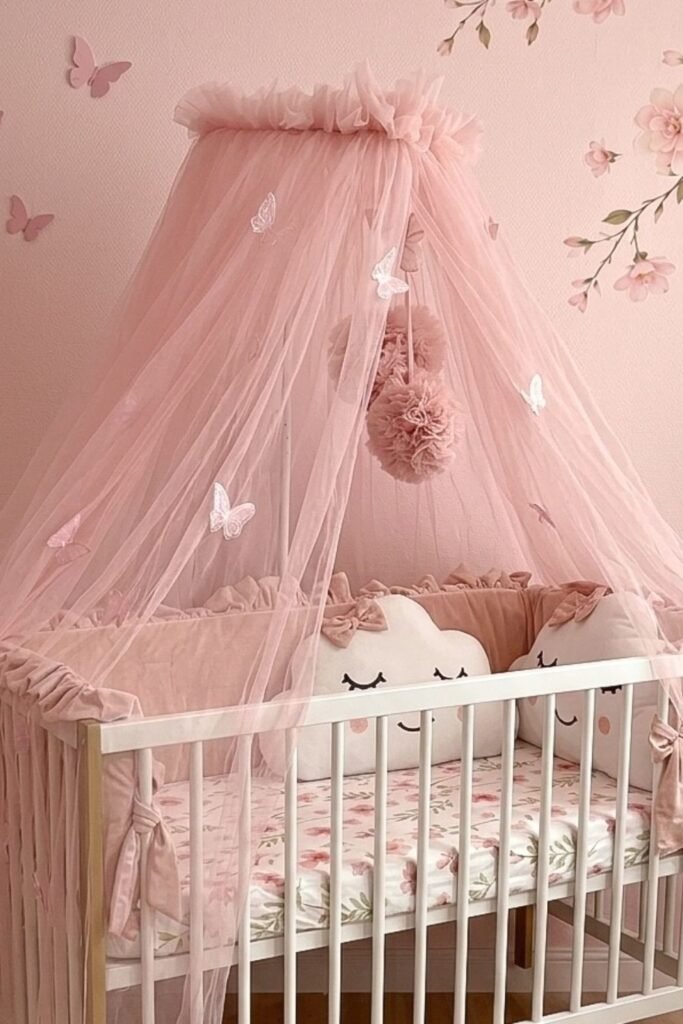
Instead of treating the crib as just a sleeping space, this setup turns it into a soft visual “room inside the room.”
The canopy takes center stage, enveloping the bed in a soft layer that instantly cuts down on visual noise and brings a more peaceful feeling to the space.
The butterfly elements are not arbitrarily scattered, but softly spread over the canopy and wall so that the eye glides leisurely rather than dart about.
This is what makes the design delicate, not overwhelming, even when the motif is completely evident.
To replicate this, start with a neutral crib foundation and build up with a sheer canopy in a single tone like blush or dusty pink.
Limit wall decorations, and add butterflies only where they contribute to the flow of the canopy.
Neutral Drift
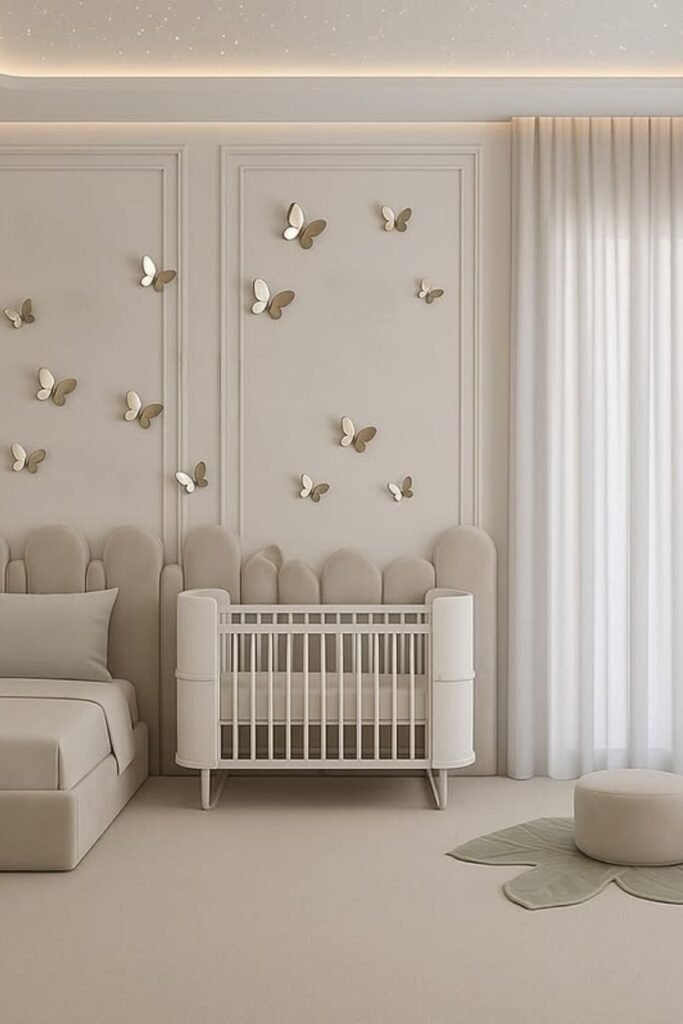
A butterfly nursery doesn’t always need color to feel soft sometimes the real impact comes from restraint.
This design works because the entire area is built on a neutral base, and the butterflies are employed as subtle accents rather than a dominant theme.
The crib is put next to a wall panel arrangement that organically frames the sleeping space, without any further adornment needed.
The butterflies are clustered in regulated clusters so they feel intentional rather than scattered, rather than filling the area with several focus points.
To create this style, choose a neutral ground such as beige, white or warm taupe. Then keep furnishings simple and in a constant tone to keep nothing breaking the visual flow.
Arched Entry
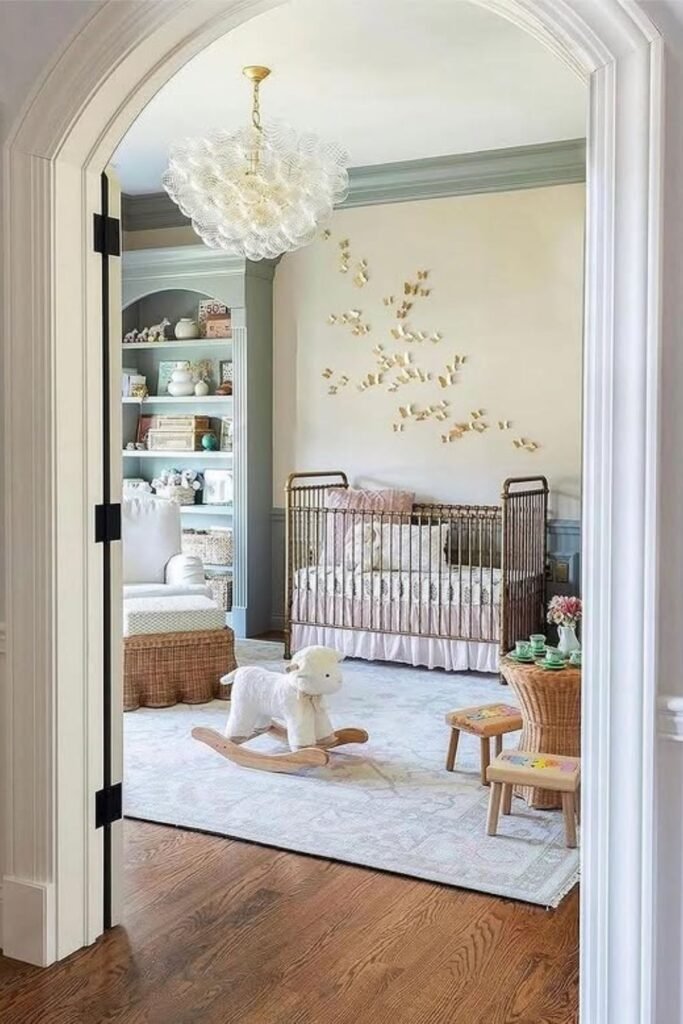
A nursery feels more intentional when the first thing you see is a framed transition instead of a direct open room.
Here the archway naturally forms a visual “pause point,” and so the nursery within appears to be a separate soft world, rather than just another room in the house.
The entrance area is not cluttered with butterflies, rather they are arranged on the main rear wall, drawing the eye deeper into the space.
This gives a layered look where your eye moves from the arch to the crib zone and then to the play corner, which makes the space feel bigger.
To replicate this, think of the entry as part of the design, not just an opening. You should tidy the entrance.
And then make a powerful focal wall within the nursery where butterfly items cluster in a controlled fashion.
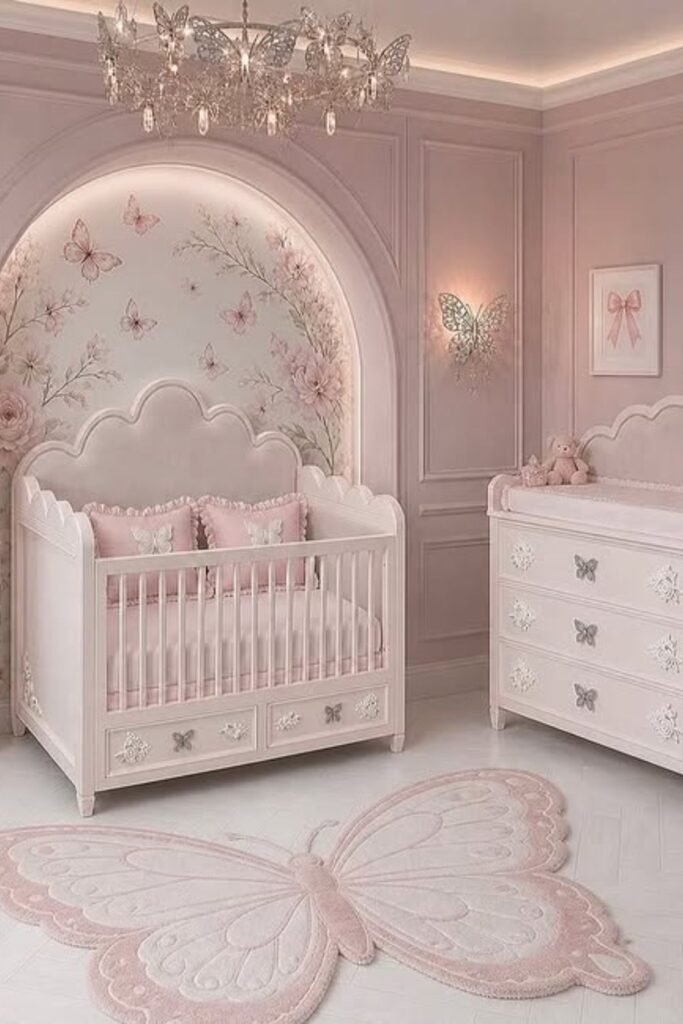
Royal Bloom
A nursery becomes instantly more timeless when you stop treating the wall like empty space and start treating it like a soft focal story.
In this design, the arched mural is the emotional fulcrum of the room, so everything else organically supports it, rather than competes with it.
The crib is positioned just in front of the painting, creating a “sleep zone” framed appearance.
Instead of just throwing random butterfly decor around, the butterflies are layered into the painted floral arch.
So they feel like they are part of the wall art, not separate decorations. This makes the room detailed but still visually controlled.
To replicate this, start with one bold feature wall, ideally a painted mural or wallpaper with depth.
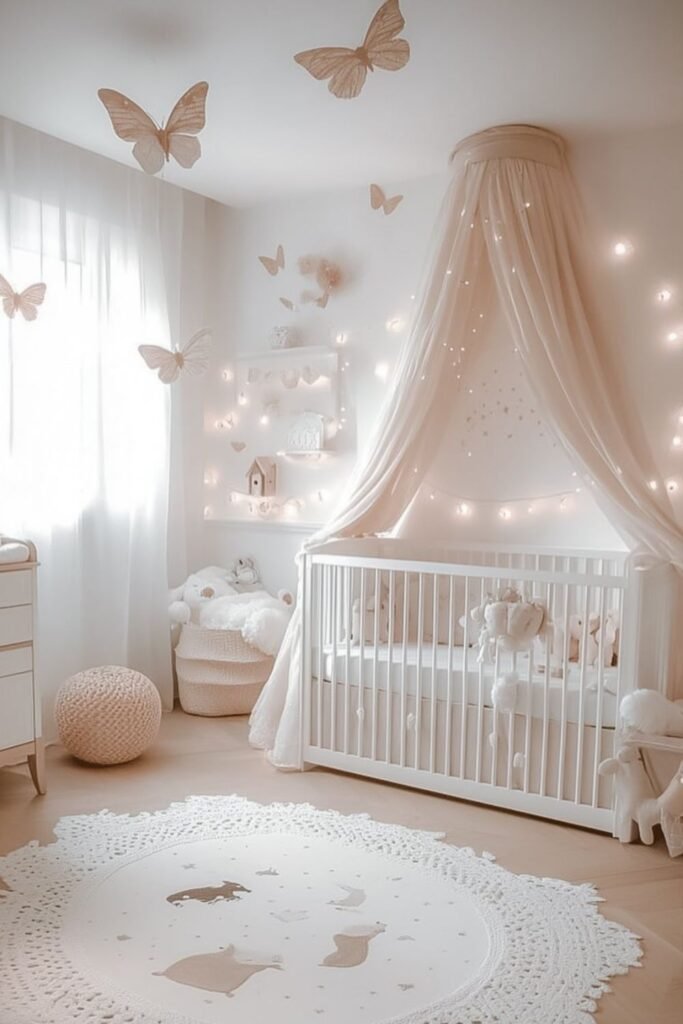
Dream Float
Letting the ceiling carry part of the design changes how the entire nursery feels. Instead of keeping everything at eye level.
Butterflies hung overhead and on the upper wall lift the room, giving it a delicate floating feel, making a tiny space feel more open.
This sense is enhanced by the canopy over the crib, which brings a little of vertical softness without heavy construction.
The warm fairy lights blend in and the environment is no longer a decorated room but a peaceful visual bubble in which all things gently away in the same direction.
Do it this way work from the top to the bottom starting with ceiling butterflies then the softness of the canopy and then the least furnishings below.
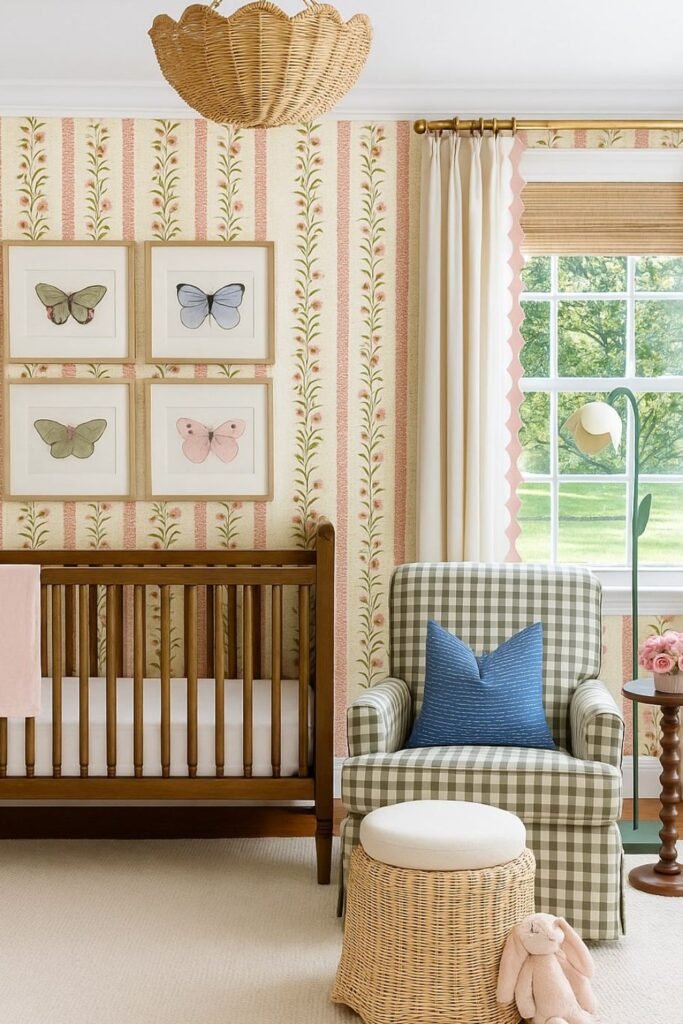
Story Frame
A nursery feels more complete when it tells a visual story instead of relying on scattered décor pieces.
The butterfly art wall here is a plotted story, with each frame adding a little change, yet together creating one peaceful visual rhythm over the crib.
The crib positioned right beneath the artwork establishes a natural grounding point.
Making the sleeping area feel grounded rather than floating in empty space. The surrounding pieces, such the chair, rug and soft materials, don’t fight the wall.
To reproduce this design, begin with one powerful “story wall” and achieve consistency through framed art rather random decor.
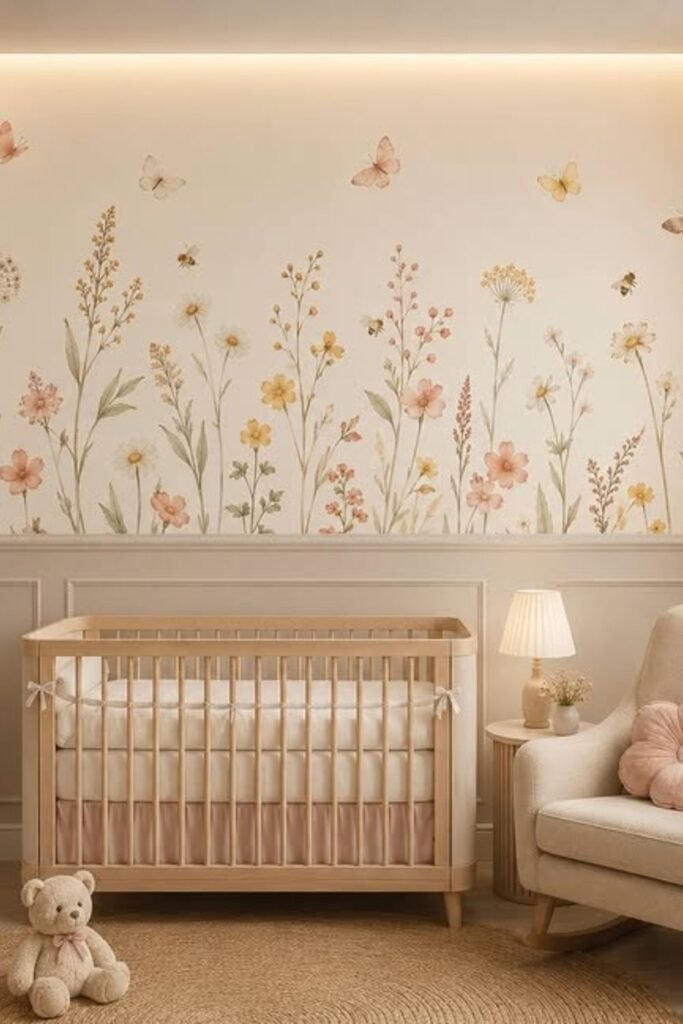
Bloom Balance
A nursery becomes instantly more calming when nature elements are blended instead of being separated into “decor pieces.”
The butterfly theme isn’t forced here. It’s rather discreetly integrated into a whole floral wall.
Which makes the area feel like one continuous soft atmosphere instead of numerous conflicting pieces.
The crib is positioned immediately under the mural, creating a natural focus point. Instead than filling the room with more butterfly artifacts.
The design allows the wall tell the tale, creating a place that is rich but not visually heavy.
Use a large nature mural or wallpaper as your base and treat butterflies as light accents rather than the main focus to duplicate this style.
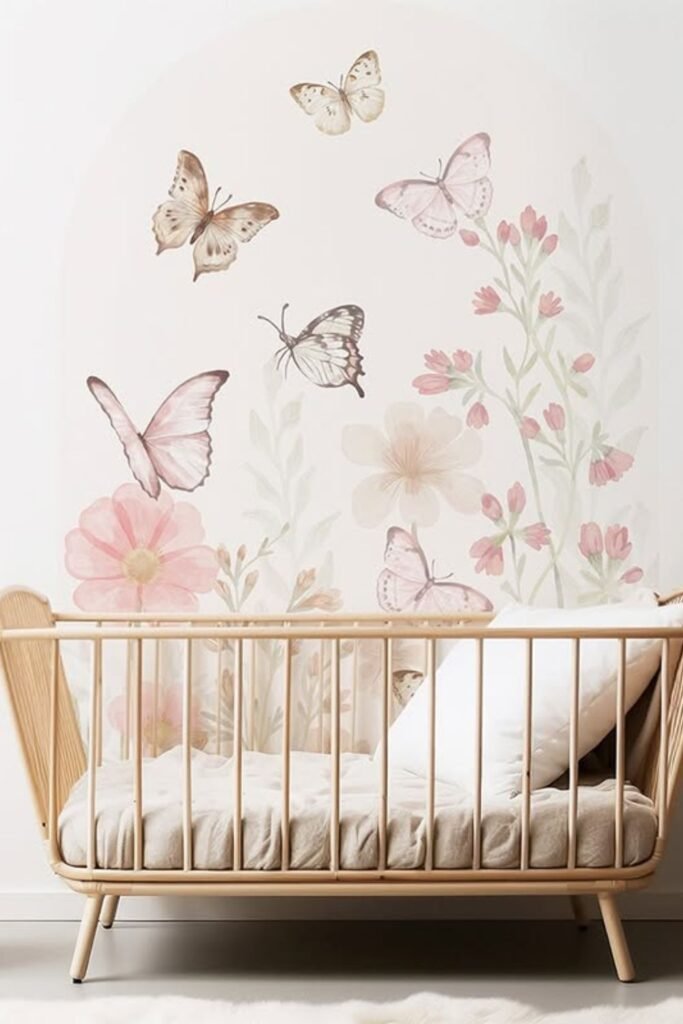
Soft Meadow
A nursery doesn’t always need bold design choices to feel complete sometimes the softness of one well-balanced wall is enough to define the entire room.
The natural focus in this setting is the butterfly and floral mural so it doesn’t require any visual cacophony surrounding it in the crib.
The design works because the butterflies are placed as if floating in the floral space, not pasted on top of it.
This brings the wall to life, yet in a tranquil way just the way a baby’s nursery should be.
The crib is located directly in front of the mural, reinforcing the link between the sleep space and visual comfort.
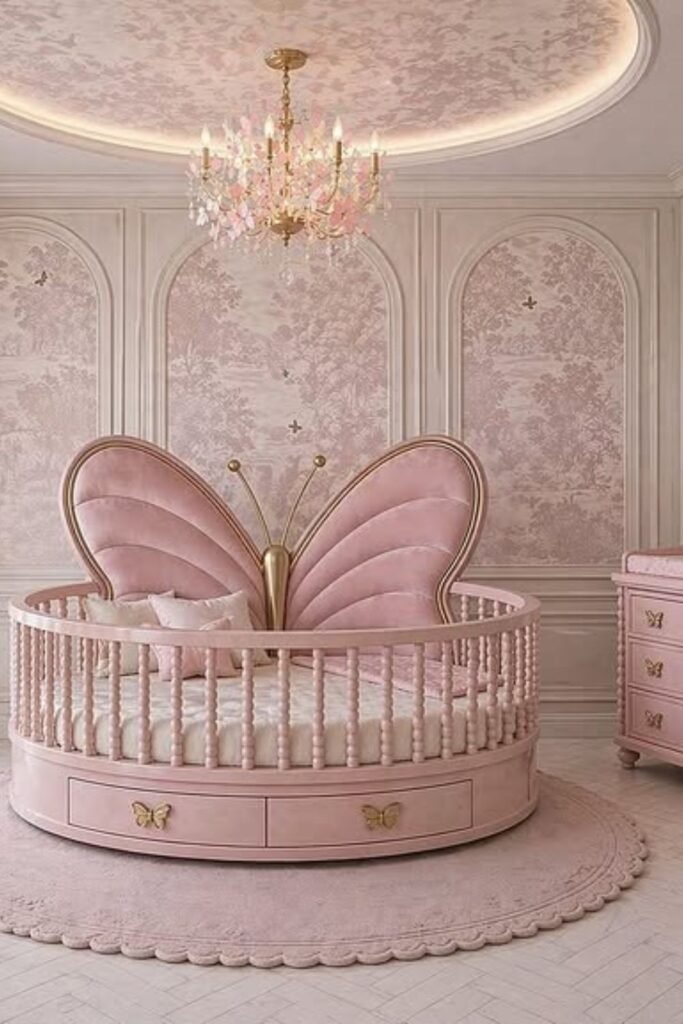
Butterfly Crown
Some nurseries don’t just use butterflies as decoration they turn them into a full identity for the room.
Here, the circular crib is the focus, almost like a stage, around which everything else is supposed to revolve.
Instead of elements being scattered across the room, the overall design pulls the eye inwards which creates a purposeful and highly styled area.
The butterfly features are part of the furniture itself, notably in the design of the cot, so there is no need for additional decorative clutter.
The wall panels and ceiling lighting emphasize the symmetry, so the room is balanced in every direction.
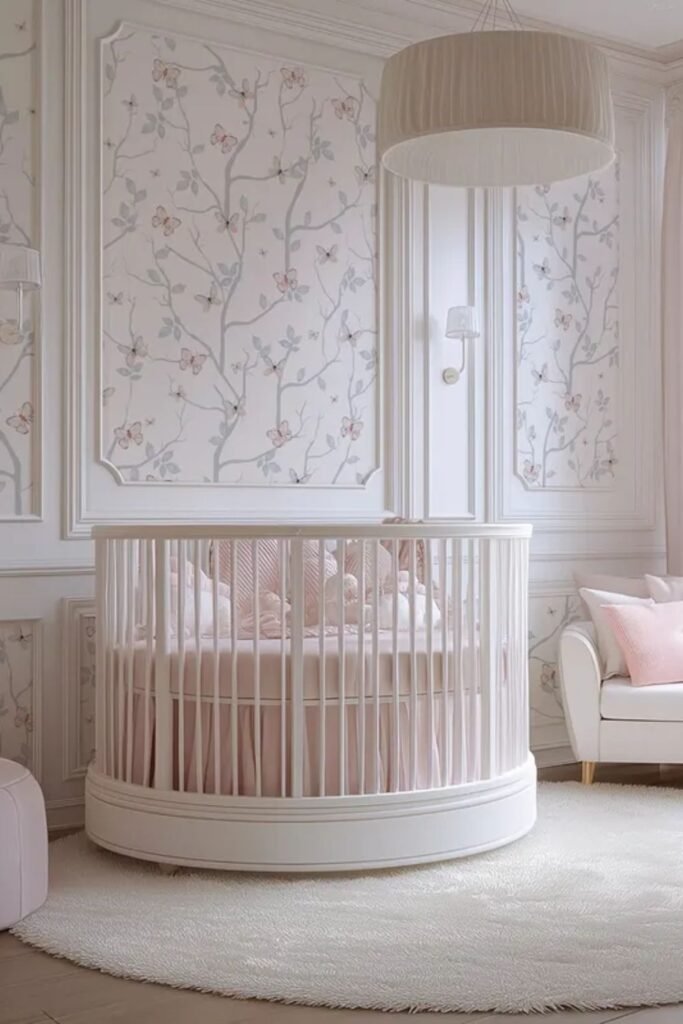
Floral Frame
A nursery feels instantly more refined when the wall design behaves like a framed artwork instead of just decoration.
Here the butterfly and flower motif is in structural wall panels giving the whole room a sense of order and tranquility and visual balance.
The circular crib placement adds to the center focus but the actual control is in the wall pattern staying within set borders.
Instead of scattering butterflies across surfaces they are part of a controlled floral composition that softens the environment without losing structure.
To copy this idea, start by thinking of your wall as a framed painting with panel molding or framed wallpaper areas.
Then, keep all your butterfly and floral pieces inside of that limit to give it a sense of intention.
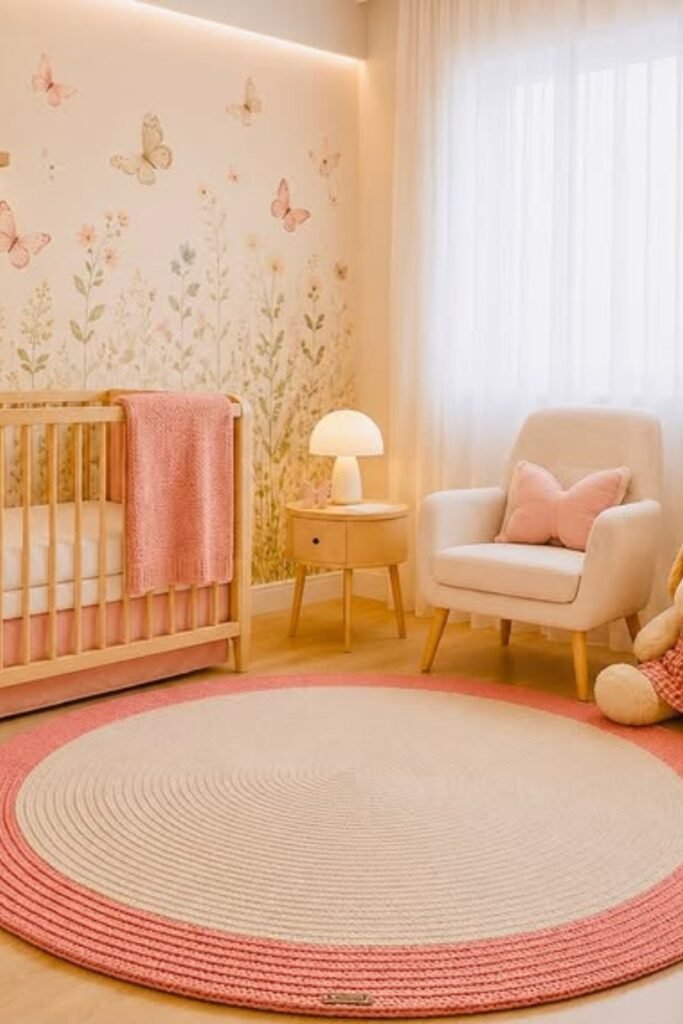
Warm Nest
A nursery feels most comforting when lighting, color and decor all work together instead of competing for attention.
The butterfly flowery wall in this configuration already offers a gentle emotional tone so everything else is meant to reinforce warmth vs increase visual noise.
The crib is positioned such that the sleep zone is aligned with the decorated wall, and the surrounding seating space.
Creates a calm parent zone that does not detract from the main focal point. The rug and furnishings with soft curves will help.
To decrease sharp visual edges and make the room feel safer and more relaxed for a newborn.
Pastel Motion
A nursery becomes visually powerful when one statement piece leads the entire design instead of multiple competing elements.
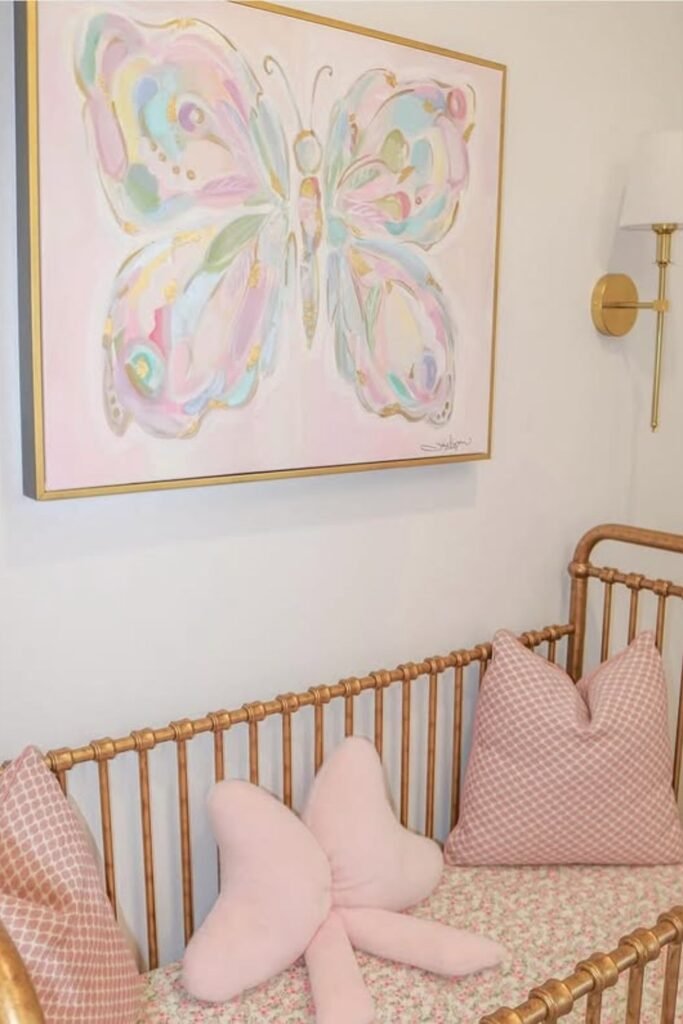
The framed butterfly artwork above the crib is the main visual anchor here, everything below is purposely gentle and muted.
The natural wood tone of the crib design makes the space not look too ornate.
The motif is based around one piece of art rather than butterfly shapes everywhere, so the space feels serene and visually airy.
The forms of the bedding and pillow work to encourage comfort without disrupting the simplicity.
Twin Harmony
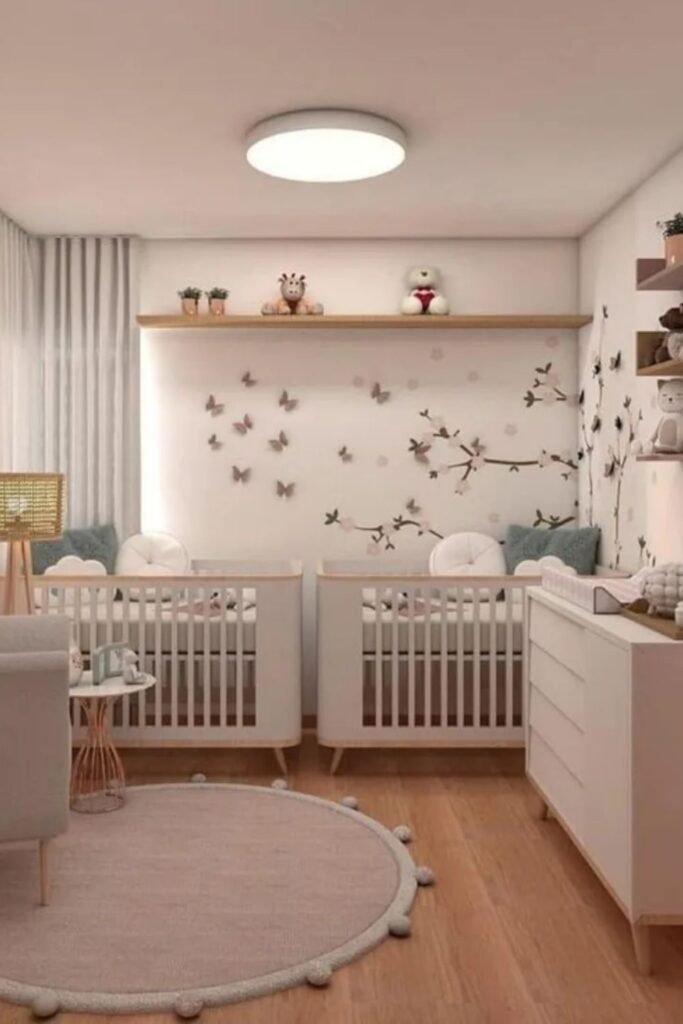
Designing a shared nursery only works when you treat symmetry as a strategy, not just decoration.
This setup two cribs side-by-side which instantly generates balance without having to reproduce every single decor element throughout the room.
The butterfly wall design is centered on one side and then let to flow across the center, so both sleeping areas feel connected rather than divided.
It prevents the typical mistake of separating twin rooms into two competing half, which makes the space look small.
To accomplish this, begin by choosing one shared focal wall instead of giving each crib its own design identity.
Glow Haven
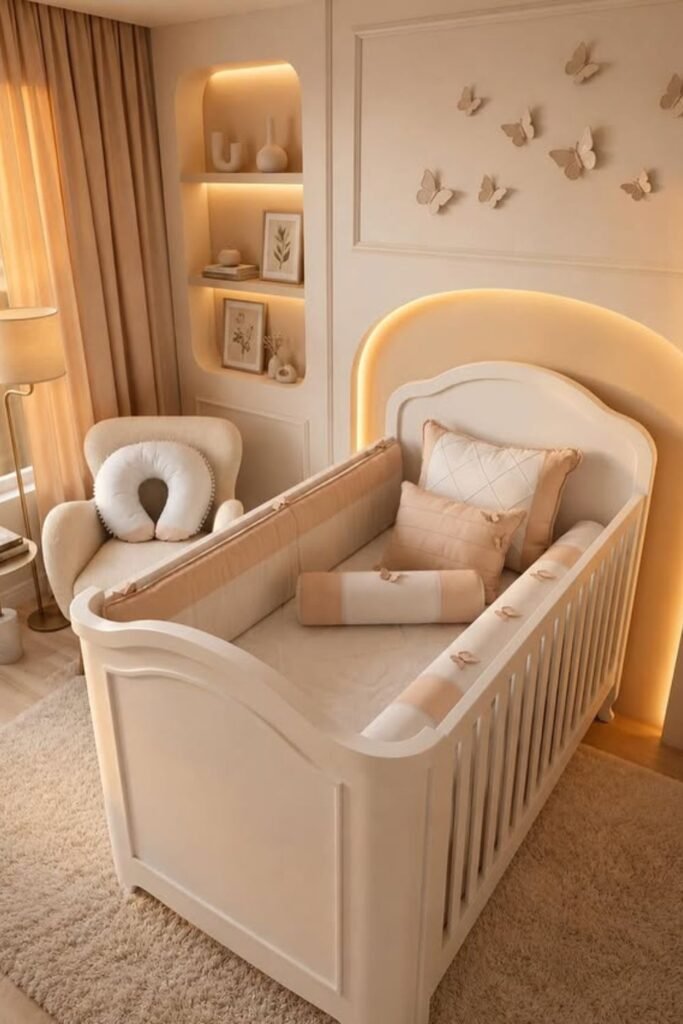
A nursery feels instantly more modern when lighting becomes part of the design instead of something added later.
The softly illuminated wall behind the crib does a lot of the emotional work here, of course.
Offering a pleasant glow that naturally attracts the eye to the sleep space without a lot of ornamentation.
The butterflies on the wall are more like floating embellishments than fixed decor, so the area still reads as tranquil even with an obvious motif.
The surrounding shelves are still basic and decorated with few objects, which does not overload the visual space and keeps the focus on the crib zone.
Butterfly Storybook
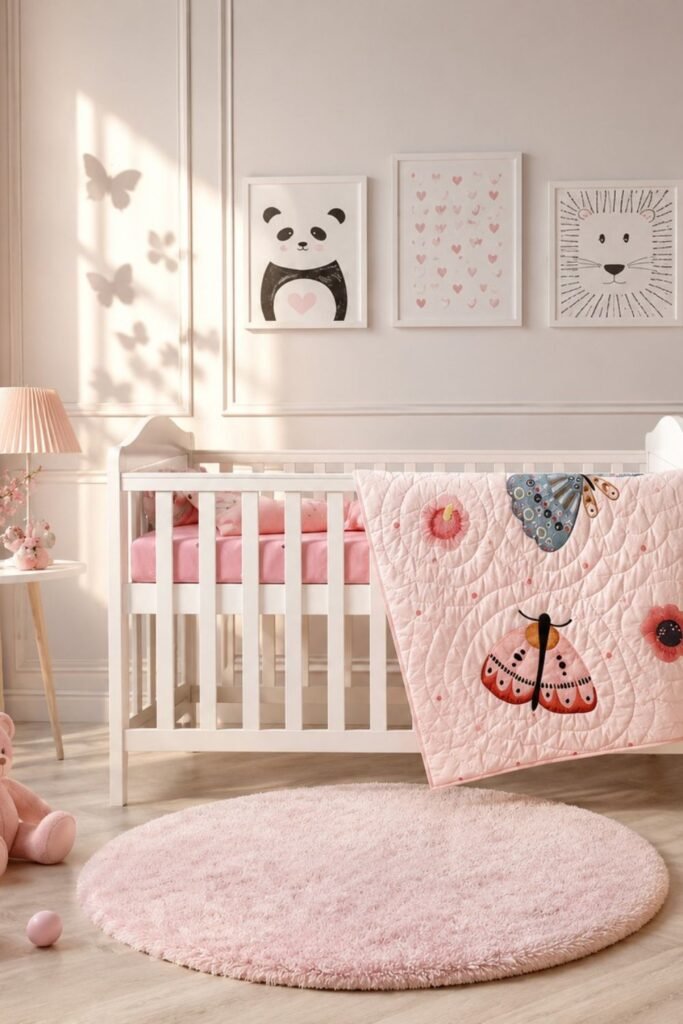
A nursery becomes more meaningful and when every element feels like part of a gentle story instead of random decoration.
In this setup the wall art works like a visual story line each framed character adds emotion.
While the butterflies and soft patterns connect everything into one calm narrative above the crib.
The crib is placed directly under this “story wall,” which makes the sleeping area feel protected and visually centered.
Instead of spreading butterfly elements across the room, they are woven into bedding and wall shadows, which keeps the design light and balanced.
To recreate this, think in layers of storytelling rather than individual decor items.
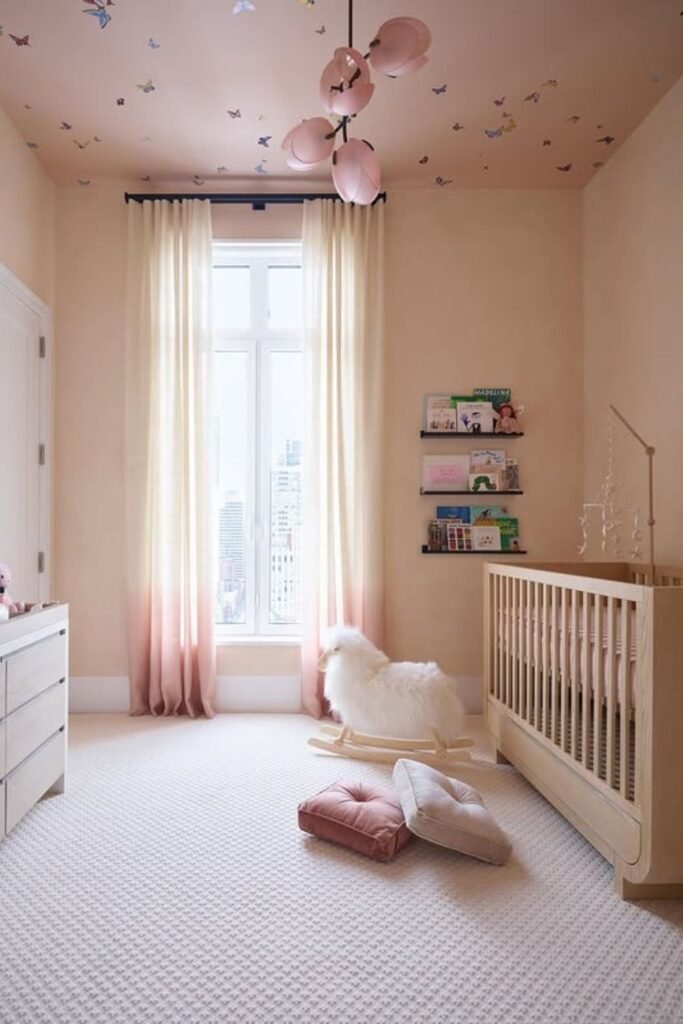
Ceiling Drift
A nursery feels more immersive when you use the ceiling as part of the story instead of leaving it plain.
Here, suspended butterflies across the ceiling produce a gentle drifting effect that makes the room feel bigger, lighter and more playful without clutter at eye level.
The location of the crib along the wall helps to ground the sleeping zone, leaving the rest of the room open for mobility and play.
The rocking toy and soft seating area help balance out the room so it doesn’t feel like it’s too focused on just one section.
It works because the visual weight is dispersed, the top, middle and floor all have a function.
FAQs
How do I stop a butterfly nursery from looking too cluttered?
It’s a matter of controlling the habitat of the butterflies, not letting them go all over the place.
They seem deliberate and calming when you use them on one focal wall, ceiling zone or crib backdrop.
Once you start repeating them all over the place walls, furniture, bedding, the design loses focus and begins to look busy rather than attractive.
What colors work best for a butterfly nursery?
Soft subdued tones are better than harsh brilliant hues. Colors such as blush pink, white, beige, lavender and sage green keep a serene setting.
But still compliment the butterfly concept. A basic palette of light hues prevents the nursery from becoming visually heavy with too many vivid colors.
Which makes the butterflies feel like they belong in the room and not over the top.

Hi, I’m Afaf! I’m a law student who loves writing about everyday life – from home projects and crafts to fashion, beauty, and parenting tips.
I’ve been writing for over a year, sharing ideas that are simple, practical, and easy to try. I write about things I find interesting and useful, whether that’s organizing a space, trying a new DIY, or finding activities to keep kids entertained.
My goal is to share helpful ideas without making things complicated. If it works in real life, I’ll write about it.
When I’m not studying or writing, I’m usually experimenting with new projects or scrolling for inspiration!